About Vidhya Puthran

Born as Chandrashkehar Sharma on the 11th December 1951 .
Also affectionately called as V.R.Raja .
Born in Tamil Brahmin family in the Udithya Gothram .
Served as Manager of Spare parts at Tafe , India for 32 years. 
Completed education in M.A.Economics , B.Ed worked as professor and later joined Tafe and also continued pursuing PG Diploma  in Marketing , Production , Foreign Trade and Materials. My passion for education made me continue above courses while working and attending evening college to secure credentials that helped my career and work. 
I was given the name of VIDHYA PUTHRAN towards the end of 2002 at Prathyangra Dvi temple , OMR (https://en.wikipedia.org/wiki/Prathyangira_Devi_Temple,_Shollinganallur) in the presence of 500 people in an totally unexpected way.
After attending a family wedding in a chance arrival at the temple happened with no planning , but Ambaal had plans for me , waiting there with 500 people , the Swamiji performing pooja called out for a person who resides in Sowbhagya Graham (the  name of my Home ) he said Ambaal herself resides in this house and asked the person to come forward , I was in total dismay and did not get up , a lady in the gathering got up and the Swamiji asked her to sit down ,he again called out saying the person residing in Sowbhagya illam please come forward , I was still hesitant but this time the Swamiji asked me to get up and come forward where I was given the name “ Vidhya Puthran  “  . It was a honor given to me by Ambaal. 
There are many more miracles and great people whom I came to meet in the past 35 years giving me profound knowledge, experience and miracles.
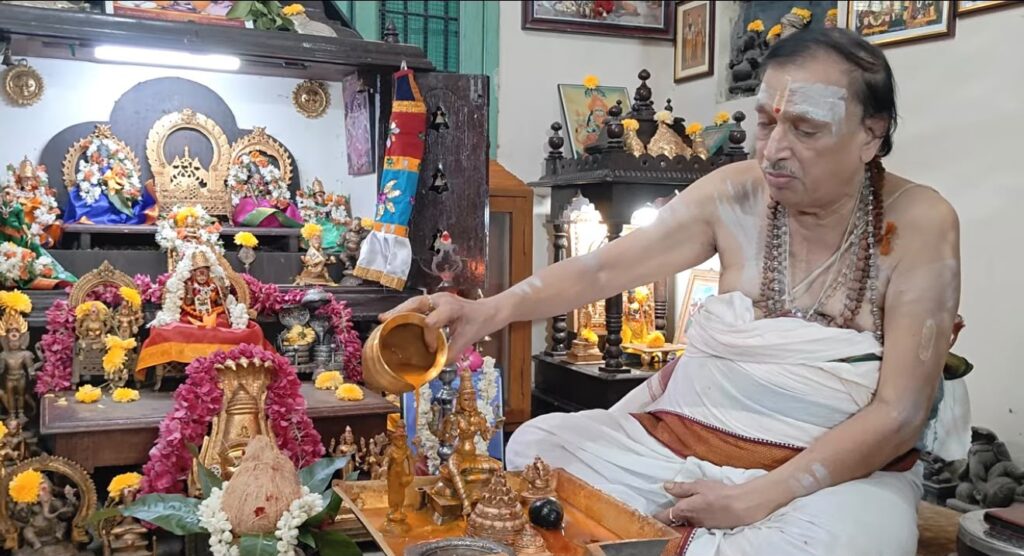
My mother has been my pillar of strength and great support of my Wife and 2 daughters. I reside in Korattur and take joy in sharing the divine knowledge and complete bliss in performing pooja for the Ambaal.

Śrītripurāstavarājaḥ

Discover the Śrītripurāstavarājaḥ, a profound hymn of praise to Śrī Tripurā / Tripurasundarī, presented with the beauty of the Sanskrit tradition and supported by IAST transliteration, English translation, and commentary.

Beginning with reverence to the Guru Maṇḍala and moving through the sacred vision of Śrīcakra, the hymn unfolds as an extensive prayer of devotion, protection, remembrance, and contemplation of the Divine Mother.